Improvements in robot policy models are often attributed to two things: larger models or more data.
In practice, however, we have found that many bottlenecks are not simply about insufficient data. They come down to three more specific questions:
- Is the existing data clean and accurate enough?
- Which actions fail, and at what moments?
- After an evaluation, can we immediately identify what to change in the next training iteration?
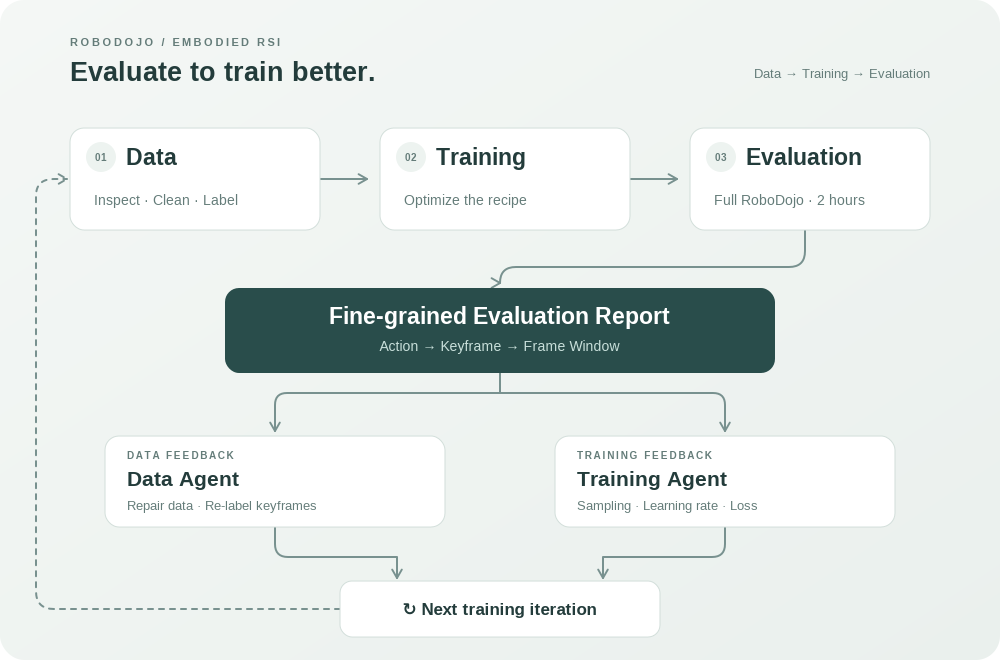
Around these questions, we have gradually built a Data → Training → Evaluation loop.
Its goal is not just to run RoboDojo faster. A complete evaluation should directly answer:
Why did the model fail, and what should we change next?
With extensive optimization by the Infra team, a full evaluation across all RoboDojo tasks now finishes within 2 hours. More importantly, those two hours produce more than a Score: they generate a fine-grained evaluation report that Data Agent and Training Agent can consume directly.
Data: Make the Data Ready for Training
Robot data is often more complicated than it appears.
A trajectory that plays back successfully is not necessarily high-quality training data. Robot arm trajectories may contain sudden jumps, abnormal velocities, local jitter, or incorrect alignment between actions and visual observations.
We therefore divide data processing into three stages:
Quality inspection → Cleaning → Annotation
Quality Inspection: Detect Anomalies in Trajectories
First, we automatically check whether the data itself is reliable.
For robot trajectories, for example, we check:
- continuity of position and rotation;
- abnormal peaks in velocity and acceleration;
- instantaneous jumps in actions;
- noticeable trajectory jitter;
- temporal misalignment between observations and actions.
Rather than simply deciding whether an episode is usable, we want to know:
Exactly which frame marks the start of an anomaly.
Data quality inspection therefore operates at the frame level.
Cleaning: Repair Rather Than Simply Delete
Detecting an anomaly does not necessarily mean discarding an entire trajectory.
If an episode contains hundreds of frames but only a short segment is uneven, a better approach is to locate the affected interval and repair it locally.
For example:
Episode #42
Frames 186–194
Abnormal jump in the rotation trajectory
The system can repair that interval while retaining the remaining valid data.
The aim is to make better use of existing data rather than continually depending on new collection.
Annotation: From Episodes to Action-Level Semantics
On top of clean trajectories, we add two types of annotation.
The first is an Atomic Action Label.
A long trajectory is decomposed into an atomic action sequence such as:
approach → grasp → lift → move → align → place → release
The second is a Keyframe Label.
Keyframes describe critical state changes during an action, such as:
- starting to approach an object;
- establishing contact;
- completing a grasp;
- starting a lift;
- completing alignment;
- releasing the object.
An episode now has an explicit temporal structure, rather than being only a continuous video and action sequence.
This provides the foundation for later failure diagnosis.
Training: Training Agent Does More Than Tune the Learning Rate
Traditional training often relies on many manual experiments.
After an experiment, engineers inspect loss curves and benchmark scores and decide:
- whether to lower the learning rate;
- whether to increase a particular loss weight;
- whether to sample a data category more frequently;
- whether to restart training from a particular checkpoint.
This process is usually slow and depends heavily on human experience.
We therefore introduce Training Agent.
Its input is not just a final Score, but the complete evaluation diagnosis report.
For example:
Precision performance has dropped substantially.
Many failures occur during grasping.
They are concentrated around keyframes immediately before and after contact.
Rotation error is significantly higher than xyz error.
This is much more useful than simply reporting a three-percentage-point drop in success rate.
Using this feedback, Training Agent can adjust:
- task, skill, and segment sampling rates;
- learning rate;
- module-wise learning rates;
- warmup and scheduler;
- loss weights;
- the length of different training stages;
- hard segment sampling;
- targeted fine-tuning.
The problem the agent addresses is therefore:
How can we find a better training recipe with fixed training data and model architecture?
This explains why performance can continue improving without adding new data.
The model may see exactly the same dataset, but:
Which data receives more training, which keyframes receive more attention, and how different losses are balanced can all change.
Evaluation: From a Score to Frame-Level Failure Analysis
Evaluation is the most critical step in the system.
Traditional benchmarks often output:
Task Success Rate = 42%
They may also provide success rates for individual tasks.
For training, however, this is still too coarse.
Knowing that an episode failed does not tell us:
Why it failed.
We therefore introduce many checkpoints during evaluation.
The analysis becomes progressively more detailed:
Task → Episode → Atomic Action → Keyframe → Frame Window
A failed episode might ultimately be described as:
Task: Pick-and-Place
Episode: #37
Failure Stage: Grasp
Critical Keyframe: Contact
Failure Window: Frames 132–148
Error: Gripper closes too early
Secondary Error: Wrist rotation deviation
The evaluation report becomes a diagnosis of failure rather than a summary of outcomes.
Crucially, we do not only look for the frame where the final failure occurs.
In robot tasks, the action that causes a failure often happens earlier.
An object may fall at frame 180, but the underlying problem may already be present at frame 140:
The grasp pose has already deviated.
The evaluation system must therefore trace:
Failure Frame → Failure Onset → Root Cause
Beyond asking when the task failed, we ask:
When did the error first begin?
One Evaluation Report Drives Two Agents
With fine-grained evaluation, the system can form a real feedback loop.
Evaluation generates a unified, structured Evaluation Report containing:
- capability-level performance;
- task-level performance;
- atomic action failure statistics;
- keyframe-level failures;
- critical frame windows;
- failure types;
- possible root causes.
The report then feeds two different agents.
Data Agent: Correct the Data
Data Agent asks:
Does the training data accurately represent the action structure the model currently needs to learn?
Suppose evaluation finds that many failures occur around grasp contact.
Data Agent can revisit the existing data’s:
- grasp action boundaries;
- contact keyframes;
- pre-grasp keyframes;
- lift-start keyframes.
If keyframe annotations are inaccurate, it can perform keyframe re-labeling directly.
This creates the path:
Evaluation → Failure Analysis → Data Re-labeling
Evaluation now helps improve the data itself.
Training Agent: Adjust the Optimization Strategy
Training Agent asks:
How should the existing data be used for training?
For example:
- increase the sampling probability of an action category;
- increase the training weight of critical frame windows;
- adjust action loss;
- rebalance learning rates across modules.
This forms a second feedback path:
Evaluation → Failure Analysis → Training Optimization
Closing the Data–Training–Evaluation Loop
The complete process can be summarized as follows:
- 01
Data
Quality inspection · Cleaning · Atomic Action / Keyframe annotation
- 02
Training
Model training · Training Agent optimization
- 03
Evaluation
Full RoboDojo evaluation · Checkpoint-based diagnosis · Action / Keyframe / Frame-level failure analysis
Fine-grained Evaluation Report
Turn failure diagnosis into feedback for data and training
Data Agent
Re-clean / Re-label
Training Agent
Adjust Sampling / LR / Loss
The biggest change is:
Evaluation is no longer the end of the pipeline. It becomes the starting point for the next round of data processing and training.
Why Can Performance Keep Improving with Fixed Data?
From this perspective, model performance depends on more than data volume.
A more complete expression is:
Performance = Data Quality × Data Utilization × Training Recipe × Evaluation Feedback
In our loop, the training dataset can remain unchanged.
Data Agent can continuously improve:
- trajectory quality;
- atomic action boundaries;
- keyframe accuracy.
Training Agent continuously optimizes:
- sampling;
- optimization;
- loss balancing;
- fine-tuning strategy.
What changes is:
How efficiently the model uses the existing data.
Rather than improving performance only through data scaling, we increase the density and utilization of useful supervision in the same dataset.
From “Evaluate after Training” to “Evaluate to Train Better”
The most important change is not that a full RoboDojo evaluation now takes only two hours.
What matters more is:
After two hours, we know what to do next.
A complete evaluation supports:
Measure → Diagnose → Attribute → Optimize
Evaluation signals become progressively more detailed, from capabilities to tasks, atomic actions, keyframes, and frame windows.
The benchmark becomes a feedback sensor within the training system, rather than merely a leaderboard tool.
The previous workflow was:
Train first, evaluate afterwards.
The workflow we want to build is:
Evaluate to train better.
When data, training, and evaluation form a real loop, improvements depend less on additional data and extensive manual trial and error.
Evaluation itself becomes part of the training capability.