
01 / OVERVIEW
Why stochastic history must move with the robot
Independent noise restarts can change the sampled behavior even when consecutive replans describe the same physical continuation.
Abstract
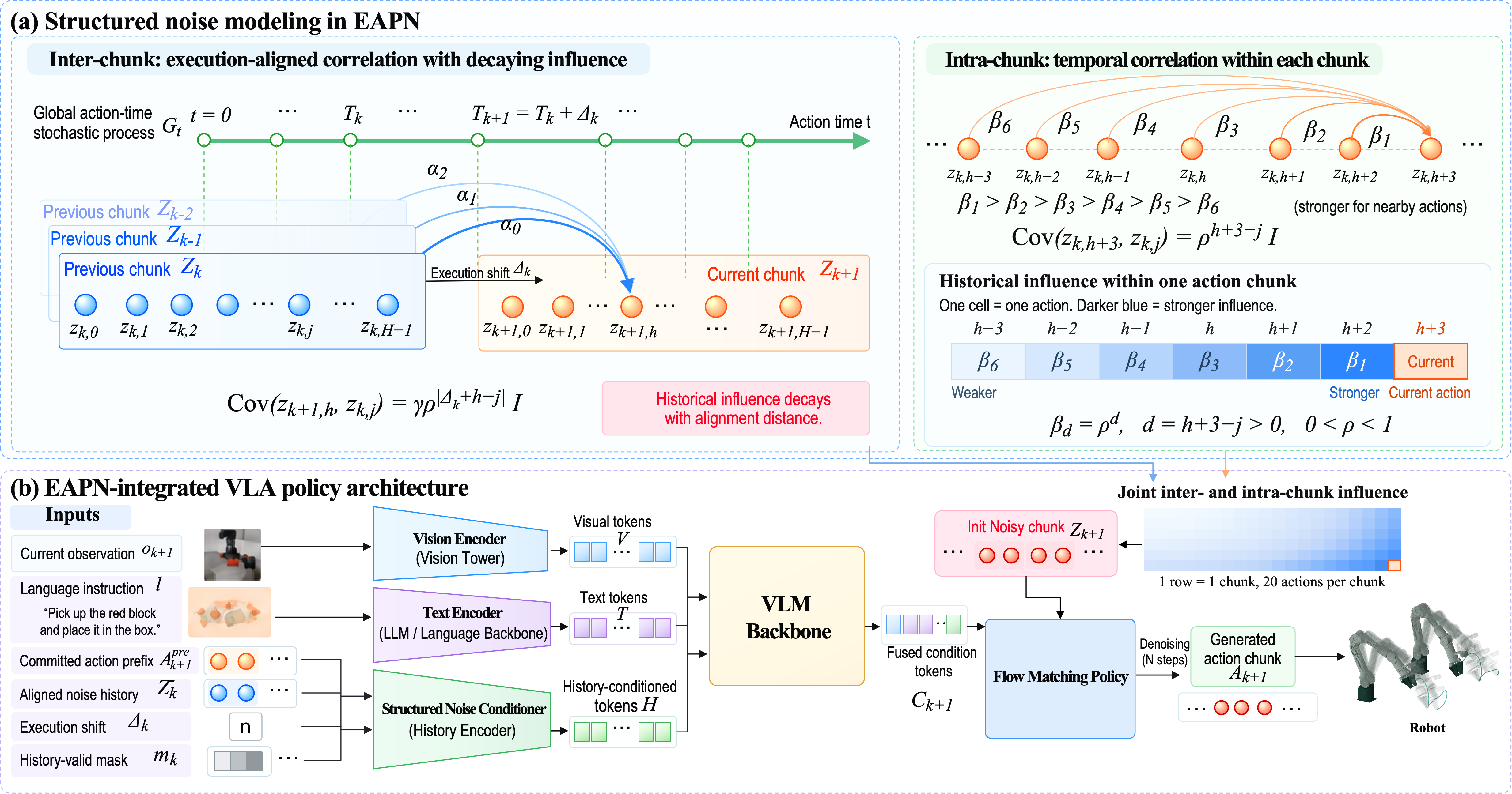
Continuous asynchronous replanning is essential for real-time generative robot policies, but independent stochastic initialization can cause mode switching and inconsistent continuation across action chunks. Execution-Aligned Progressive Noise (EAPN) introduces structured stochasticity at both inter-chunk and intra-chunk levels. Across replanning steps, EAPN propagates a shared noise trajectory and aligns it with actual execution displacement. Within each action chunk, it models temporal correlation along action time. The aligned stochastic history is combined with committed action context so that subsequent chunks continue from execution-consistent generative states instead of restarting from independent noise.
02 / METHOD
Continue the latent process, not just the action output
EAPN replaces independent per-call initialization with a jointly trained structured source. A persistent shared AR(1) trajectory carries stochastic state across policy calls and is advanced by the robot's actual execution displacement, while a private AR(1) process models temporal correlation within each action chunk.
At every replan, the previous source noise is shifted into the current action-time window and encoded together with execution displacement, inference delay and a history-validity mask. The flow policy keeps the committed action prefix fixed, generates only the remaining suffix, and resets the history state at episode boundaries.
EMPIRICAL MOTIVATION
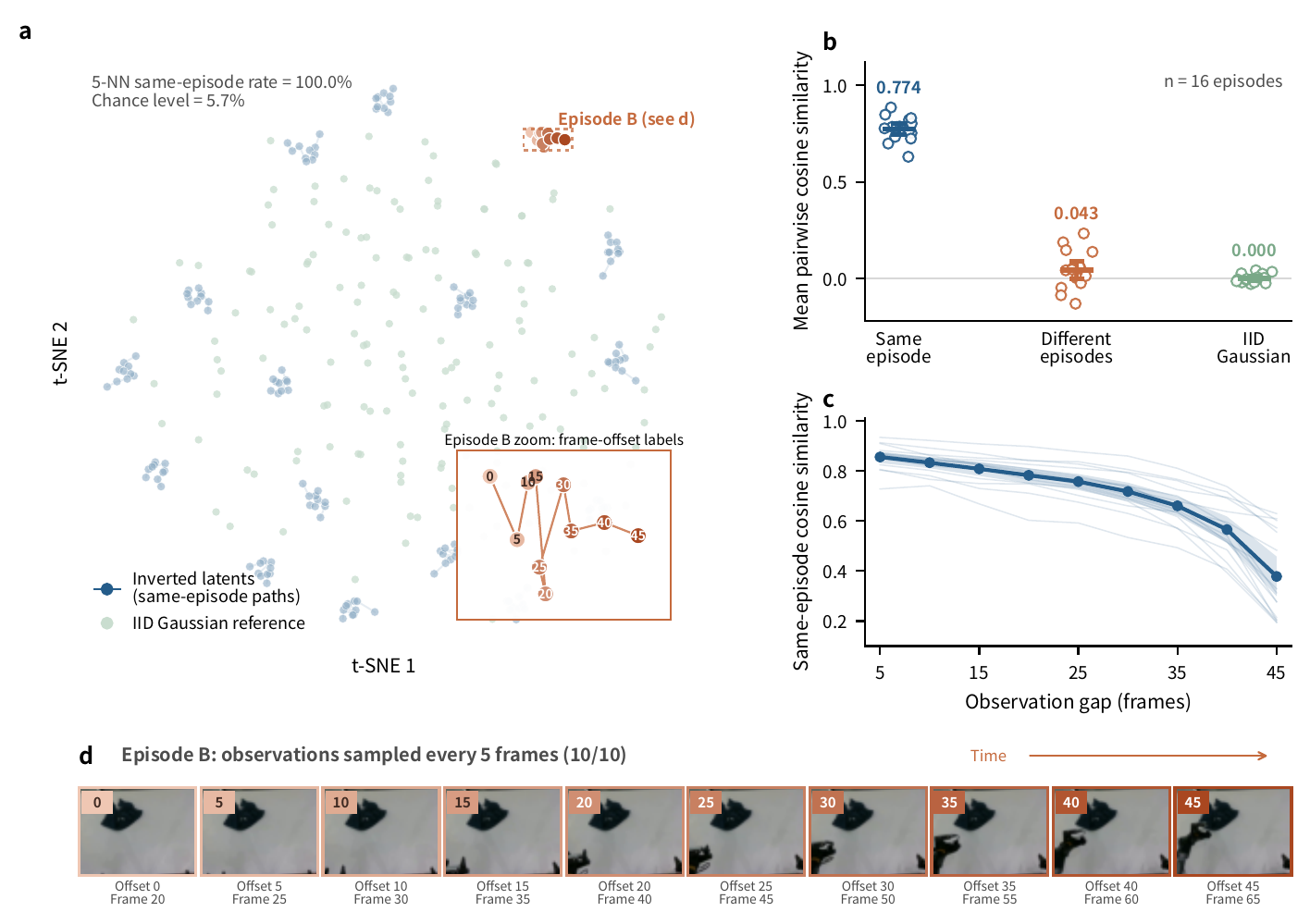
INVERSIONInverted latents retain episode identity
EXECUTION ALIGNMENT
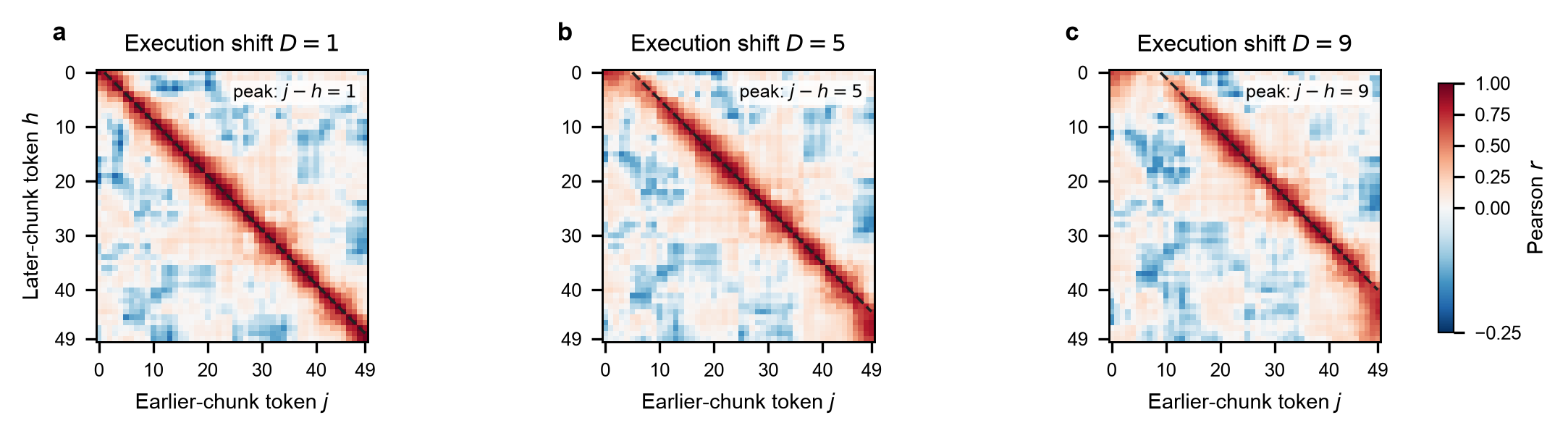
LATENTLatent correlation follows execution
03 / QUANTITATIVE RESULTS
Consistency across simulation and real robots
EAPN reduces mode switching and remains robust as asynchronous inference delays increase.
D3IL · AVOIDING
Behavioral consistency
| Method | Success ↑ | MSR ↓ | Switch Gap ↓ |
|---|---|---|---|
| DDPM-ACT | 73.13% | 3.969% | 0.001913 |
| EAPN | 78.96% | 3.167% | 0.001672 |
LIBERO · HIGH INFERENCE DELAY
Average success rate
| Method | D = 5 | D = 10 | D = 15 |
|---|---|---|---|
| VLASH | 71.5% | 70.3% | 68.3% |
| T-RTC | 89.8% | 80.3% | 73.0% |
| EAPN | 88.3% | 83.0% | 75.0% |
AGILEX-PIPER · REAL WORLD
Task success rate
| Method | Object Storage | Cloth Folding |
|---|---|---|
| Naive Async | 65.0% | 63.3% |
| RTC | 80.0% | 60.0% |
| T-RTC | 80.0% | 63.3% |
| VLASH | 85.0% | 93.3% |
| EAPN | 90.0% | 96.7% |
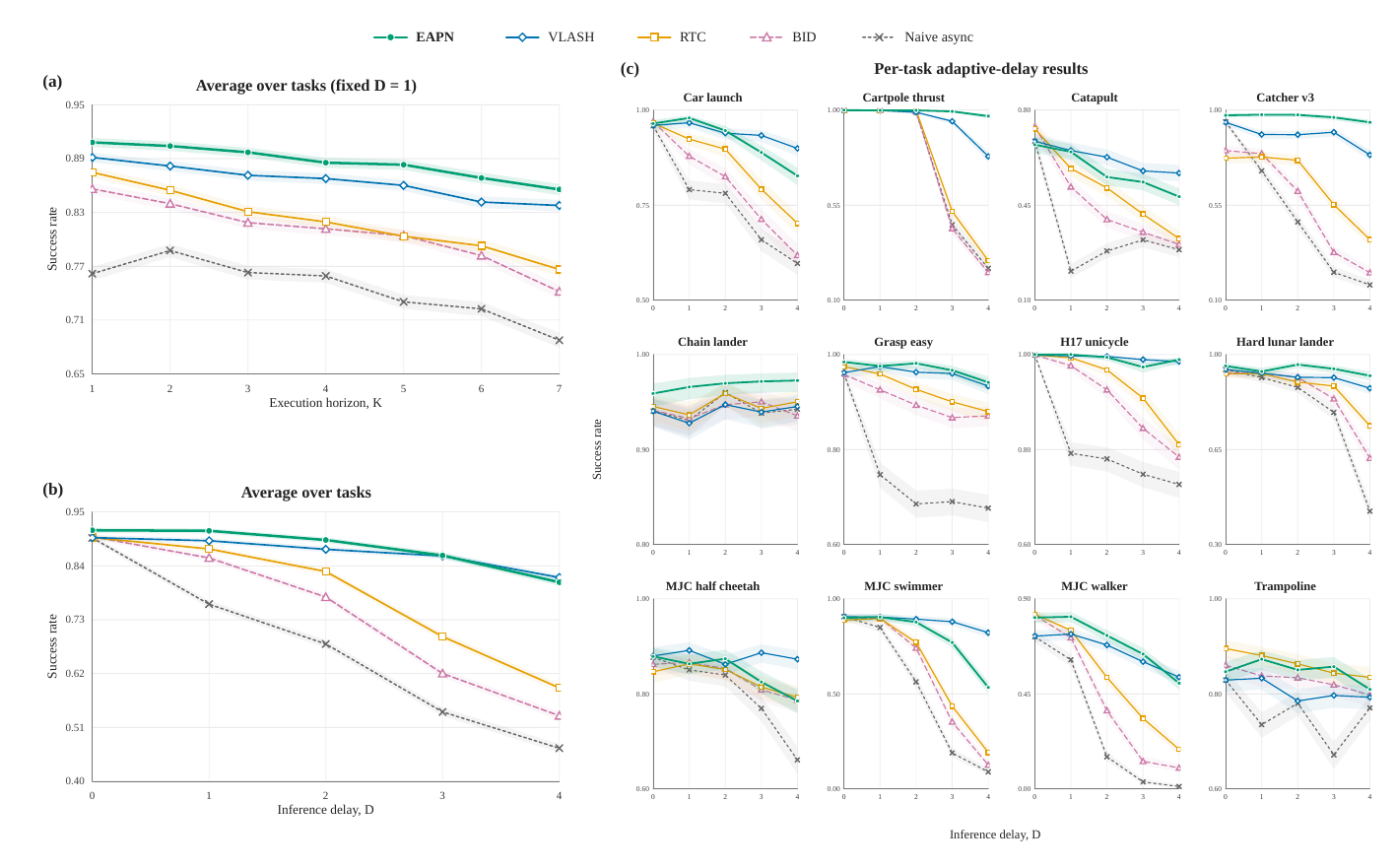
KINETIX
Robustness across execution horizons and inference delays
04 / LIBERO LONG DEMONSTRATIONS
Compare the motion, side by side
D = 20 and K = 25. Each pair uses the same task, episode and seed. Videos play automatically at original speed.
CASE 01 · TASK 9 · EPISODE 8
21.4% lower EEF jerkMicrowave placement and door closing
EAPN · OursSUCCESS
EAPN · SEED 1008ORIGINAL
Comparison baselineREFERENCE
NO-CORRELATION · SEED 1008ORIGINAL
Both methods succeed. For this rollout, EAPN also reduces the recorded action second-difference metric by 22.7%.
CASE 02 · TASK 5 · EPISODE 5
15.1% lower EEF jerkBook placement into the caddy
EAPN · OursSUCCESS
EAPN · SEED 1005ORIGINAL
Comparison baselineREFERENCE
NO-CORRELATION · SEED 1005ORIGINAL
Both methods succeed. For this rollout, EAPN also reduces the recorded action second-difference metric by 17.1%.
05 / REAL-WORLD COMPARISON
Object storage and cloth folding
The left recording shows EAPN; the right recording shows the corresponding comparison baseline. All videos retain their original frame rate and duration.
CITATION
BibTeX
@misc{eapn2026,
  title = {Execution-Aligned Progressive Noise for Consistent Asynchronous Replanning in Generative Robot Policies},
  author = {Di Wu and Ping Liu and Xuhua Chen and He Zheng and Lingfeng Zhang and Tao Zhang},
  year = {2026},
  eprint = {2610.06090},
  archivePrefix = {arXiv},
  primaryClass = {cs.RO},
  url = {https://arxiv.org/abs/2610.06090}
}